 TechBlonhub A new digital technology era.
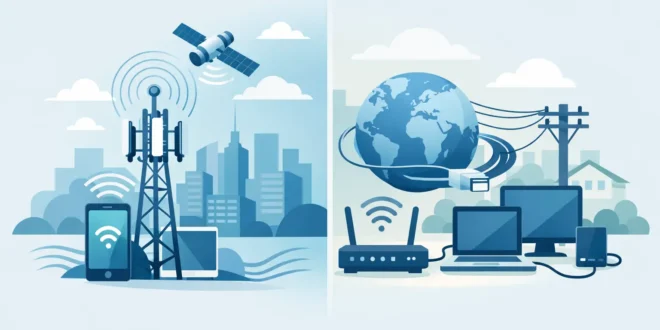

You notice broadband prices creeping up, your contract expires, and suddenly 5G home internet looks a lot more tempting. That is usually when the real question hits: can 5g replace broadband internet, or is it only good enough until a wired connection is available again? The honest answer is that 5G can replace broadband for some homes and small offices, but not for all of them.
This is not just a speed question. It comes down to consistency, latency, local network congestion, building materials, and how heavily you rely on video calls, cloud apps, gaming, or large file transfers. If you are choosing between a fixed broadband line and 5G, the smart move is to look past the marketing and judge each option by actual use.
Can 5G replace broadband internet for most users?
For many light to moderate users, yes, it can. If your household mostly streams video, browses the web, uses social apps, and handles routine work tasks, 5G home internet may feel close enough to cable or fiber that the difference barely matters day to day. In some locations, it may even outperform older DSL connections by a wide margin.
But “most users” is not the same as “all users.” Broadband still has structural advantages because it is usually delivered over dedicated wired infrastructure into the property. That tends to produce more stable speeds and more predictable latency, especially during busy evening hours. 5G is wireless by design, and wireless performance always varies more.
So the better framing is this: 5G can replace broadband when your local 5G coverage is strong, your usage is not extremely demanding, and the service remains stable during peak times. If any of those pieces are weak, broadband still wins.
Where 5G home internet makes the most sense
The strongest case for 5G replacement is in places where fixed broadband options are limited, overpriced, or outdated. If your only wired choice is slow DSL, a decent 5G signal can be a major upgrade. This is especially true in suburban or semi-rural areas where fiber has not arrived and cable performance is inconsistent.
It also makes sense for renters, people who move often, and small businesses that want faster setup. A 5G gateway is usually simple to install. You place the device where signal quality is strongest, power it on, and connect your devices. No technician visit, no drilling, and usually less waiting.
There is also a pricing angle. Some 5G home internet plans are straightforward, with fewer surprise fees than traditional broadband packages. If a provider offers competitive pricing with decent speeds and no long contract, that can be a practical win.
Where 5G still falls short
The weak spot is consistency. A wired broadband line is generally less vulnerable to the environmental factors that affect wireless networks. With 5G, speed can shift based on tower load, weather conditions, nearby interference, and even where you place the gateway inside the building.
That matters more than many buyers expect. A service that tests at 300 Mbps at noon but drops sharply in the evening is not really equivalent to a broadband line that holds steady. The issue is not only peak speed. It is whether the connection behaves the same way when everyone in the neighborhood gets online.
Latency can also be a problem for certain workloads. Standard browsing and streaming are fine with moderate latency, but competitive gaming, VoIP quality, remote desktop sessions, and some cloud-based workflows benefit from lower and more stable ping times. Fiber is still the benchmark there, and cable often performs more predictably than 5G as well.
Another issue is carrier-grade network management. Some providers may prioritize mobile traffic differently from home internet traffic, or apply soft data policies that affect performance after certain usage levels. Unlimited does not always mean unlimited at full quality.
Speed is only part of the story
5G marketing tends to highlight impressive theoretical speeds, but practical buying decisions should focus on four things: download speed, upload speed, latency, and stability. A connection that is merely fast on paper can still be frustrating in daily use if uploads are weak or the signal fluctuates.
For example, a home office user uploading large project files, syncing cloud storage, and joining frequent video meetings may care more about reliable upstream performance than headline download numbers. That is one reason some cable and especially fiber connections remain better suited for remote work and business use.
Household density matters too. A single user streaming shows and checking email can thrive on 5G. A household with multiple 4K streams, gaming consoles, smart home devices, and two people on work calls at the same time puts a lot more pressure on a variable wireless link.
Fiber, cable, DSL, and 5G compared
Fiber is still the best replacement-proof option if it is available and affordable. It usually offers the best mix of speed, low latency, and reliability, and it handles heavy multitasking better than almost anything else in the consumer market.
Cable remains a strong middle ground. It can deliver very good speeds, though performance may slow during neighborhood congestion. Even so, cable is often more predictable than 5G for heavy users.
DSL is where 5G often shines by comparison. If your current broadband line is old, slow, and unstable, a strong 5G connection can absolutely be the better choice. This is why blanket statements about 5G replacing broadband are misleading. It depends heavily on what kind of broadband you are comparing it against.
In practical terms, 5G competes well with weak broadband and sometimes decent cable. It does not consistently beat fiber, and it is not guaranteed to beat a well-performing cable setup.
Can 5G replace broadband internet for work and business use?
It can, but only with caution. For a solo remote worker with solid local coverage, 5G may be perfectly workable. Email, SaaS platforms, messaging apps, CRM tools, and video conferencing can all run well on a good 5G home internet connection.
For small businesses, the answer gets more nuanced. If uptime matters, if you run point-of-sale systems, support VPN-heavy workflows, manage surveillance cameras, or rely on large cloud backups, broadband usually remains the safer primary connection. In those cases, 5G often works better as a backup WAN option than as the only link.
That backup role is actually one of 5G’s biggest strengths. Many IT teams already use cellular failover for business continuity because it is fast to deploy and can keep critical services online during a wired outage. That is a strong argument for 5G in the network stack, even when it is not the main connection.
What to check before you switch
Before replacing broadband with 5G, test your local reality instead of trusting carrier maps. Coverage maps are useful, but they do not tell you how your specific building performs. Walls, window coatings, nearby structures, and indoor placement all affect signal quality.
Check real-world speeds at different times of day. Evening performance matters more than off-peak tests. Ask whether the provider has data deprioritization policies. Look at the return window, equipment terms, and whether the router supports external antennas if reception is weak.
You should also think about your internal network. A strong internet signal does not help much if the bundled gateway has weak Wi-Fi coverage. In larger homes or busy small offices, you may need a mesh system or a better router setup behind the 5G gateway.
The decision comes down to risk tolerance
If you want the simplest answer, here it is: 5G can replace broadband internet when convenience, price, and decent performance matter more than maximum consistency. Broadband still leads when your connection is mission-critical, your workload is heavy, or you have access to fiber.
That does not make 5G a compromise in every case. For some users, it is the smarter buy right now. The key is to treat it as a local service, not a universal category. One neighborhood can have excellent 5G home internet, while another a few miles away gets wildly different results.
If you are deciding today, compare not just plans, but failure points. Ask what happens on your busiest workday, during evening congestion, or when everyone at home is online at once. The best connection is not the one with the flashiest speed claim. It is the one you stop thinking about because it keeps up with real life.