 TechBlonhub A new digital technology era.
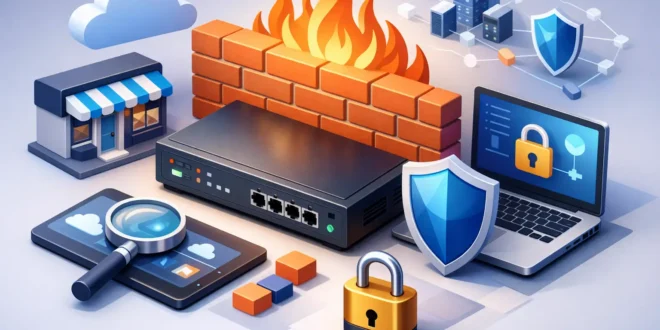

That cheap router from the office supply store may still get everyone online, but it will not give your business much room for error. If you are comparing options right now, this small business firewall buying guide is built to help you avoid the two most common mistakes: buying a weak box that cannot keep up, or paying for enterprise features your team will never use.
A firewall for a small business is not just a filter that blocks bad traffic. It sits at the edge of your network and decides what gets in, what gets out, and how much visibility you have when something looks wrong. For a company with cloud apps, remote staff, VoIP phones, cameras, payment systems, or guest Wi-Fi, that decision affects uptime as much as security.
What a small business firewall actually needs to do
Most buyers start with brand names and model numbers. That is backward. Start with the job.
A small business firewall should inspect traffic, enforce security rules, support secure remote access, segment different parts of the network, and give you enough reporting to spot problems before they become outages. In practical terms, that means separating office devices from guest Wi-Fi, protecting employees who connect from home, and stopping obviously malicious traffic without turning your internet connection into molasses.
This is where marketing can muddy the water. Many products advertise next-generation threat protection, AI detection, deep packet inspection, and cloud-managed security. Some of that matters. Some of it is just feature inflation. If your company has 12 employees, relies on Microsoft 365, uses a couple of cloud apps, and has no dedicated IT staff, easy management and reliable VPN access may matter more than an advanced sandboxing feature that adds cost and complexity.
Small business firewall buying guide: start with your network reality
Before you compare vendors, map out how your network is actually used. Not how you think it is used, and not how the spec sheet assumes it is used.
Count your users, devices, and internet connections. Then look at traffic types. A design firm pushing large files, a retail shop using POS systems, and a dental office handling patient data all need security, but they do not stress a firewall in the same way. Video calls, cloud backups, security cameras, and site-to-site VPN traffic all change the performance picture.
You should also ask how much of your traffic is encrypted. Modern firewalls can inspect encrypted traffic, but that feature often cuts real-world throughput hard. A firewall rated at several gigabits on paper may deliver far less when security services are turned on. That is one of the easiest ways to underbuy.
If your business plans to grow within the next 18 to 24 months, buy for that future state, not just today. Replacing a firewall too early is annoying. Rebuilding remote access, security policies, and VLANs around a new platform is worse.
Throughput matters, but not the way many buyers think
Vendors love headline numbers. You will see firewall throughput, threat protection throughput, VPN throughput, and sometimes SSL inspection throughput. They are not interchangeable.
For a small business, the important figure is usually the speed with security services enabled. If you pay for intrusion prevention, malware filtering, application control, and web filtering, you need to know what performance looks like when those are active. Otherwise you bought protection you cannot realistically use.
A good rule is simple: leave headroom. If your office has a 500 Mbps internet connection, do not buy a firewall that barely reaches that speed with security inspection turned on. Aim higher so normal growth and peak traffic do not create a bottleneck.
Ports, PoE, and connectivity choices
Not every firewall is just a security appliance. Some small business models also include switch ports, Power over Ethernet, or built-in Wi-Fi. That can be convenient in a tiny office or branch location, but convenience has trade-offs.
An all-in-one box reduces hardware count and can be easier to deploy. On the other hand, dedicated firewalls often scale better and give you more flexibility if you later upgrade switching or wireless separately. If you already run managed switches and business access points, a dedicated firewall is usually the cleaner long-term choice.
Look carefully at port speed too. Gigabit ports are still common, but multi-gig internet and faster internal uplinks are becoming more relevant, especially for businesses using NAS, local servers, or heavy cloud sync workloads.
Security features worth paying for
This is where a lot of buyers either overspend or get too cheap.
Stateful firewalling is basic. Any serious business firewall should have it. The more useful step up is intrusion prevention, which can detect and block known attack patterns. Web filtering is also worth real attention because many business infections still start with unsafe browsing, malicious ads, or compromised sites.
Application awareness can be useful if you want to prioritize or limit categories of traffic, but it matters more in some businesses than others. If you are not planning to enforce app policies, it should not drive your purchase.
VPN support remains critical. Even if your team is mostly in the office, remote access for owners, IT support, and hybrid staff is now standard. Make sure the firewall supports both the number of users you need and a VPN experience people will actually use. Secure but painful remote access tends to become unused remote access.
High availability is another feature that sounds excessive until your internet edge fails during business hours. Many small businesses skip it because of cost, and that is understandable. But if downtime is expensive, it is worth comparing a pair of lower-tier firewalls against one larger unit.
The subscription question that changes total cost
Here is where many firewall purchases go sideways. The hardware price is only part of the spend.
Most modern firewalls require ongoing licenses for advanced security services, cloud management, support, and firmware access. A device that looks affordable upfront can become expensive over three or five years. Another model may cost more at the start but include better features or lower renewal costs.
This is why you should compare total cost of ownership, not sticker price. Include hardware, licenses, support, installation time, and any management overhead. If one platform saves your team hours each month because policies are easier to manage and alerts make sense, that value is real.
Be careful with entry-level devices that lock important features behind premium subscriptions. If VPN, reporting, or content filtering are essential, confirm exactly what is included before you buy.
Cloud-managed vs locally managed firewalls
This choice depends on who will own day-to-day administration.
Cloud-managed firewalls are often the better fit for small businesses without a full-time network admin. They make deployment, updates, monitoring, and multi-site control simpler. If you manage several offices or rely on an outside IT provider, central visibility is a major advantage.
Locally managed appliances can still make sense if you want tighter on-prem control, already have networking expertise, or prefer not to tie management to a vendor cloud portal. The trade-off is usually convenience. For smaller teams, convenience often wins for good reason.
Just do not confuse cloud-managed with maintenance-free. You still need policy reviews, firmware planning, user access controls, and alert monitoring.
Common buying mistakes to avoid
The first mistake is buying on raw throughput alone. Security features change performance, and real workloads are messy.
The second is ignoring segmentation. If your firewall cannot cleanly separate guest Wi-Fi, cameras, VoIP, and business systems, you are giving yourself more risk and less control than necessary.
The third is underestimating ease of management. A firewall with every feature in the world is not helpful if nobody understands the interface well enough to maintain it.
The fourth is failing to plan for remote work. Even small offices now need reliable remote access and clear visibility into who is connecting and from where.
The fifth is assuming setup is a one-time project. Firewalls need updates, policy tuning, and occasional cleanup. The easier a platform makes that work, the more likely it will actually get done.
How to narrow your shortlist
By this point, you should be able to filter choices fast. Focus on a handful of questions. Can the firewall handle your internet speed with the security services you want enabled? Does it support your remote access and segmentation needs? Is management realistic for your team? And what does the full three-year cost look like?
If two models seem close, the better buy is often the one with the clearer interface, better reporting, and less painful licensing. Security products do not live on spec sheets. They live in real offices, with limited time, occasional outages, and people who need simple answers when something breaks.
For many small businesses, the right firewall is not the most advanced one. It is the one that protects the network consistently, supports growth without drama, and does not turn routine management into a weekly headache.
Buy with your real traffic, real staff, and real budget in mind. A firewall should reduce risk, not create a new kind of complexity.