 TechBlonhub A new digital technology era.
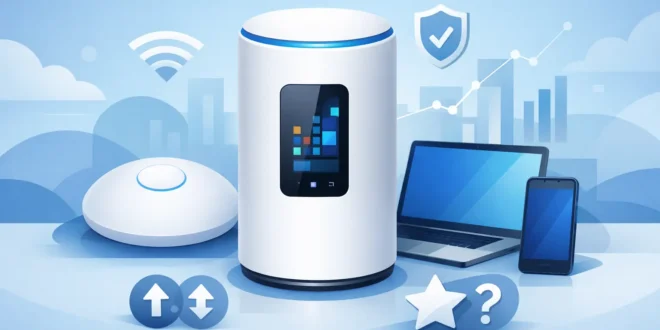

If your current router is doing that familiar small-business trick – working fine until everyone joins a video call at once – the Ubiquiti Dream Machine starts to look appealing fast. This ubiquiti dream machine review is for buyers who want more control than a basic consumer router offers, but do not want to build a full rack just to get reliable Wi-Fi, security features, and cleaner network management.
Ubiquiti has spent years attracting two kinds of users at the same time: home enthusiasts who want enterprise-style tools, and IT teams that want decent visibility without enterprise pricing. The Dream Machine, often called the UDM, sits right in that overlap. It promises an all-in-one gateway, switch, access point, and UniFi controller in a single device. That sounds efficient. It also sounds like a compromise. In practice, it is a bit of both.
Ubiquiti Dream Machine review: what it actually is
The original Dream Machine is a cylindrical desktop unit with a built-in security gateway, a managed four-port switch, an integrated Wi-Fi access point, and the UniFi Network controller software running on the device itself. That last part matters because it removes a common barrier to UniFi adoption. You do not need a separate Cloud Key or always-on controller just to manage your network.
For a small office, home office, lab, or power-user household, that is a strong pitch. You get one dashboard for VLANs, guest networks, traffic stats, firewall rules, device grouping, and remote management. Compared with standard ISP hardware, the jump in visibility is huge.
But the Dream Machine is not the same thing as the Dream Machine Pro or the newer UniFi gateway options. If you are expecting rackmount expansion, advanced WAN flexibility, or a direct path into heavier camera and security appliance workloads, this is not that product. The regular UDM is simpler, smaller, and more constrained.
Setup and day-to-day management
The best thing about the Dream Machine is that it makes UniFi far less intimidating than it used to be. Setup is guided through the app, the interface is cleaner than older UniFi generations, and most users can get a basic network online without much drama.
That does not mean it is as foolproof as a mainstream mesh kit. Ubiquiti still assumes the buyer has at least some networking literacy. If terms like VLAN, DPI, IDS/IPS, and port profiles already make sense to you, the UDM feels friendly. If they do not, you can still use it, but parts of the interface may feel like you bought more network than you currently need.
Once deployed, management is one of the biggest reasons to buy it. The UniFi dashboard gives you useful visibility into connected clients, bandwidth use, topology, Wi-Fi performance, and security settings without turning every task into command-line work. For SMB owners and solo IT admins, that balance is valuable. You get professional-looking controls without the overhead of traditional enterprise gear.
Performance in the real world
As a router, the Dream Machine is generally strong for gigabit-class internet and busy local traffic. For many homes and small offices, it handles routing, NAT, and multiple connected devices well. General responsiveness is good, and the integrated access point can deliver solid wireless coverage in modest spaces.
The catch is that performance depends heavily on what features you enable. This is where many glowing first impressions run into reality. Turning on security services such as intrusion detection and prevention can reduce throughput compared with the headline speed people expect from a simple router benchmark. That is not unusual in networking hardware, but it matters if you are buying the UDM specifically for high-speed internet plus always-on inspection.
Wi-Fi performance is decent to very good, but not magical. In apartments, smaller homes, and compact offices, the built-in radio often does the job well enough on its own. In larger buildings, awkward floor plans, or environments with dense walls, you may still need additional access points. That changes the value equation because the all-in-one simplicity starts to fade once you expand the deployment.
Latency-sensitive tasks like video meetings, cloud apps, and gaming are usually handled well when the network is configured properly. Still, if your environment has dozens of active users, heavy east-west traffic, or a lot of segmentation, you may start to notice that the Dream Machine is closer to prosumer than true business edge hardware.
Security features and why they matter
One reason the Dream Machine stays relevant is security. It offers a real step up from most consumer routers in terms of firewall control, network segmentation, and traffic inspection options. Creating separate networks for staff, guests, smart home gear, or test devices is much easier here than on typical retail hardware.
That alone can justify the purchase. Too many small organizations and advanced home users run everything on one flat network and hope for the best. The UDM makes better habits practical. Guest isolation, VLANs, content controls, and policy-based restrictions are all much more approachable in UniFi than on bargain routers.
That said, it is not a replacement for a dedicated next-generation firewall in every business scenario. Deep security reporting, compliance-focused controls, and advanced threat management are limited compared with products built specifically for that role. If your network supports regulated workloads, sensitive customer data, or multiple sites with strict policy requirements, you may outgrow it quickly.
For everyone else, the Dream Machine lands in a useful middle ground. It gives you enough control to materially improve network hygiene without pushing you into enterprise licensing and management complexity.
Hardware design, ports, and limitations
This is the section where an honest ubiquiti dream machine review needs to slow down. The Dream Machine is attractive and compact, but the hardware choices create obvious constraints.
You get four LAN ports on the integrated switch, which is enough for a small desktop setup but not enough for many offices. Once you connect a modem, a desktop, a VoIP phone, maybe a printer, and an uplink to another switch, those ports disappear fast. The lack of PoE on the built-in switch also matters more than many buyers expect. If you plan to add UniFi access points or cameras later, you may need separate PoE switching anyway.
The all-in-one design is convenient until one part of the device no longer fits your needs. Maybe the router is fine but the Wi-Fi standard starts to feel old. Maybe you want more ports. Maybe your ISP setup becomes more complex. With separate components, you upgrade one piece at a time. With the UDM, the convenience comes with a ceiling.
This is why the Dream Machine works best when you buy it for a clearly defined deployment size. If you already know you are likely to expand into multiple access points, advanced WAN failover, larger switching needs, or heavy camera integration, starting with a more modular UniFi setup may be smarter.
Who should buy it
The Dream Machine makes the most sense for three groups. First, power users who are tired of consumer routers and want better visibility, VLAN support, and cleaner management. Second, small offices that need stable networking and decent security without hiring a full-time network engineer. Third, IT-minded households with lots of connected devices and a real need to separate work, guest, and IoT traffic.
It is less ideal for very basic users who just want plug-and-play Wi-Fi with no learning curve. It is also not the best fit for larger businesses, multi-site deployments with stricter demands, or buyers who already know they will need rackmount gear, advanced redundancy, or a lot of wired ports.
Price matters here too. The Dream Machine is rarely the cheapest way to get online. What you are paying for is the UniFi ecosystem, centralized control, better segmentation, and a cleaner upgrade path than random retail networking gear usually offers. If you will actually use those advantages, the price can make sense. If you just need Wi-Fi for a few phones and a streaming box, it may be overkill.
Verdict
The Ubiquiti Dream Machine is still a compelling all-in-one network appliance because it solves a real problem: the gap between flimsy consumer routers and more complex business gear. It gives you strong management tools, meaningful security features, and solid performance in a package that is much easier to live with than older prosumer networking setups.
Its weaknesses are just as real. Port count is limited, expansion has trade-offs, and the all-in-one design can become restrictive as your network grows. That does not make it a bad buy. It means you should buy it for what it is now, not what you hope it becomes later.
If your goal is a smarter, more controlled network for a home office, small business, or serious home setup, the Dream Machine still earns consideration. Just be honest about your growth plans before you put it at the center of your network.