 TechBlonhub A new digital technology era.

Access Point vs Extender: Which Wi-Fi Solution Is Better for Your Network?
A dead zone in the back office, weak coverage upstairs, or buffering during meetings usually leads to one question: access point vs extender — which one actually fixes Wi-Fi without wasting money?
The truth is, both improve coverage, but they solve different problems. Choosing the wrong one often results in stronger signal bars but the same frustrating performance.
For homes and businesses upgrading their infrastructure alongside routers, switches, or enterprise networking setups like those deployed by Gearnet Technologies, this decision directly affects long-term Wi-Fi reliability and network efficiency.
Why Wi-Fi Coverage Problems Are Not Just “Signal Issues”
Most users assume weak Wi-Fi is purely a signal strength problem. In reality, it is usually a mix of:
- Poor router placement
- Limited wireless coverage area
- Network congestion from too many devices
- Structural interference (walls, floors, metal surfaces)
This is why simple signal “boosting” does not always solve performance issues. The real question is whether you need better reach or better network architecture.
Access Point vs Extender: The Core Difference
The difference is not just technical — it is structural.
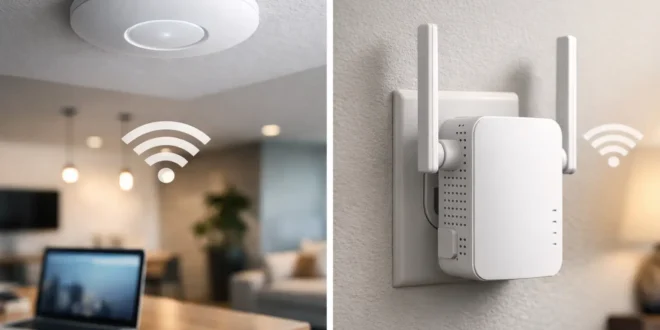
An access point creates a new Wi-Fi network using a wired Ethernet connection. It acts as a dedicated network extension point, delivering fresh, stable connectivity from the main router or switch.
An extender, on the other hand, repeats your existing wireless signal and rebroadcasts it. It improves reach but depends entirely on the quality of the signal it receives.
In simple terms:
- Access point = builds new strong coverage using cable
- Extender = stretches existing weak signal wirelessly
That distinction defines everything: speed, stability, and long-term reliability.
When an Access Point Is the Better Solution
If you can run Ethernet, an access point is almost always the stronger option.
It is ideal for environments where network performance cannot drop, such as:
- Offices with video calls and cloud apps
- Homes with remote work setups
- Retail or business spaces with multiple users
- CCTV and smart device-heavy environments
Because it uses Ethernet backhaul, it avoids wireless congestion and delivers consistent performance even under heavy load.
Key advantage:
It behaves like a properly engineered network expansion node, not a signal repeater.
The trade-off is planning — cabling, mounting, and setup take more effort than plug-and-play devices.
When a Wi-Fi Extender Makes More Sense
An extender works best when convenience matters more than performance.
It is useful in situations like:
- Rental homes where wiring is not possible
- Temporary setups or quick fixes
- Small dead zones like patios or guest rooms
- Light usage environments
Extenders are simple to install and cheaper upfront, but they rely heavily on receiving a strong base signal.
The limitation:
Every wireless hop introduces performance loss, especially in crowded or interference-heavy environments.
So while coverage improves, network speed consistency often does not.
Performance Reality: What Actually Changes
On paper, both devices “extend Wi-Fi.” In real usage, performance depends on how data travels.
Access point setup:
- Direct wired connection
- Lower latency
- Stable throughput under load
- Better for multiple simultaneous users
Extender setup:
- Wireless relay system
- Additional transmission delay
- Reduced bandwidth in busy networks
- Sensitive to placement
This is why many users report “full signal but slow internet” with extenders — the issue is not coverage, it is network efficiency.
Cost vs Long-Term Value
Extenders usually win on upfront cost, but access points often win on long-term value.
- Extender: cheaper, faster setup, limited scalability
- Access point: higher initial cost, stronger long-term performance
In growing networks — especially small businesses or modern smart homes — investing in proper network expansion infrastructure often reduces future upgrades and troubleshooting.
Mesh Networks: The Middle Option
Mesh systems sit between access points and extenders.
They:
- Improve roaming between nodes
- Reduce dead zones more intelligently
- Can use wired or wireless backhaul
When wired backhaul is used, mesh nodes behave similarly to access points. Without it, they behave closer to advanced extenders.
How to Decide Without Overcomplicating It
Ask three practical questions:
- Can Ethernet be installed in the weak coverage area?
- Is the connection used for work, streaming, or critical devices?
- Will the network grow in the future?
If the answer is “yes” to most of these, an access point is the better long-term choice.
If the need is temporary or lightweight, an extender is usually sufficient.
Final Takeaway: Access Point vs Extender
The debate is not about which device is “better” — it is about which problem you are solving.
- Choose an extender for quick, low-cost coverage fixes
- Choose an access point for stable, scalable network performance
The best networks are not just about stronger Wi-Fi signals — they are about designing coverage that stays consistent when usage increases.
Related article: WiFi 5 vs WiFi 6: Speed, Performance & Upgrade Guide
FAQs
1. What is the main difference between an access point and an extender?
An access point uses a wired Ethernet connection to create a new Wi-Fi zone, while an extender rebroadcasts an existing wireless signal.
2. Which is faster: access point or extender?
Access points are generally faster because they use wired backhaul instead of repeating wireless signals.
3. Do access points reduce Wi-Fi congestion?
Yes, they reduce congestion by creating independent network access points instead of relying on a single repeated signal.
4. Can I use both access points and extenders together?
Yes, but performance is better when access points are used as the primary expansion method and extenders only for minor coverage gaps.
5. Which is better for gaming and video calls?
Access points are better due to lower latency, more stable bandwidth, and consistent performance under load.

Author: AJ
As a passionate blogger, I'm thrilled to share my expertise, insights, and enthusiasm with you. I believe that technical knowledge should be shared, not hoarded. That's why I take the time to craft detailed, well-researched content that's easy to follow, even for non-tech. I love hearing from you, answering your questions, and learning from your experiences. Your feedback helps me create content that's tailored to your needs and interests